
Ask someone in the Philippines about Banaba, and you may hear about a grandmother who boiled the leaves into tea. Ask a product developer in Europe, and you might hear about corosolic acid percentages and certificate formats. Both people are talking about Banaba Extract, and yet they seem to describe two different things. One story comes from household habits, while the other comes from lab reports and purchasing files. The space between those two stories is where most of the confusion sits, and it is worth walking through slowly.
Why does that gap matter? If you plan to put Banaba Extract into a formulation, the claims you can make, the specs you request and the questions you ask all depend on knowing which evidence is solid and which is still thin.
Where Banaba Comes From
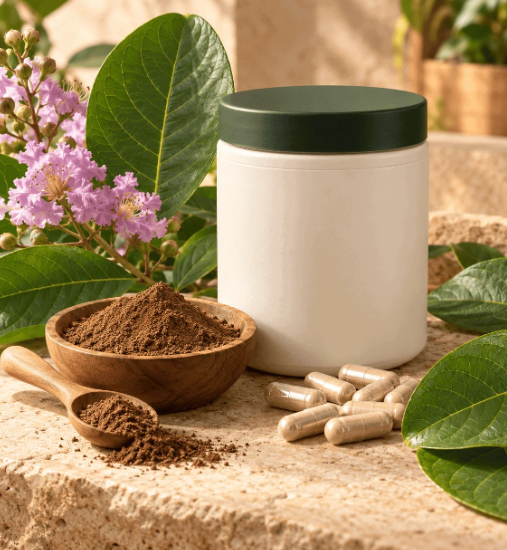
Banaba is the common name for Lagerstroemia speciosa, a flowering tree that grows in India, Southeast Asia and the Philippines. It can reach around 20 metres, and many towns plant it as a roadside ornamental tree.
Most extracts come from the leaves. That detail sounds small. It matters later, when you look at what a supplier actually standardises.
Traditional Use of Banaba Leaves
Here is the part people usually find interesting first. Folk medicine across the Philippines and Southeast Asia has used Banaba leaf for blood sugar concerns for a long time. Leaf decoctions were also recorded as diuretics and purgatives, while bark and root were used for stomach complaints.
Tradition, though, records what people did. It is not a record of what worked, and it says little about dose, preparation or consistency between households.
That distinction gets lost in a lot of marketing copy. You have probably seen it yourself.
What Current Research on Banaba Extract Shows
Let’s break it down by study type, because the strength of evidence changes a lot from one type to the next.
Lab and animal work. Most published research sits here. Several rodent studies have reported effects on blood glucose and body weight. Cell studies have also looked at corosolic acid in tumour cell lines, which is a long way from any human use.
Human studies. This is where things get thinner. Reviews of the medical literature found few quality clinical trials, along with a handful of small or open-label studies. One frequently cited trial involved just 10 people taking a leaf extract standardised to 1% corosolic acid for 10 days.
Ten people, ten days. That is a starting point, perhaps, not a conclusion.
A 2020 review in Current Traditional Medicine also flagged that the purified compounds appear to have low bioavailability. The authors called for more preclinical and clinical work on mechanisms, absorption and toxicity.
Corosolic Acid and Ellagitannins in Banaba Extract
Most commercial Banaba extracts carry a corosolic acid figure on the spec sheet. That makes sense, since researchers mention it most.
But corosolic acid is not the whole picture. A 2011 review in Phytotherapy Research linked the reported activity to both corosolic acid and ellagitannins. An extract standardised only to corosolic acid tells you nothing about the ellagitannin side.
So, which marker should you ask for? Honestly, it depends on what your product claims and what your target market allows. Some buyers request both. Others only need one. There is no single right answer here, and anyone who says otherwise is probably selling something.
See Also: Home Security Decoded: Choosing Multi-Point Locking Systems for Maximum Safety
The Gaps Between Tradition and Evidence
This is where the title earns its name. A few gaps stand out:
- Dose: Clinical data are too limited to support dosing recommendations.
- Duration: Reliable information on long-term use is lacking, with documented safe use reaching only about two weeks.
- Special groups: Evidence on pregnancy and breastfeeding is insufficient.
- Preparation: A boiled leaf tea and a standardised dry extract are not chemically the same product.
The 2011 review reported no adverse effects in animal studies or controlled human trials. That is reassuring, though “not observed” in small studies is different from “proven safe” across a whole population.
What This Means for Your Product Claims
Next steps, if banaba is on your formulation list:
- Check what your target market permits on labels and marketing. Rules differ a lot between regions.
- Keep tradition and research in separate sentences in your copy, so readers do not confuse the two.
- Avoid treating rodent results as human outcomes.
- Ask for a named marker compound and a named test method on the certificate.
- Confirm the plant part, which should normally be leaf.
Brands that stay careful here tend to face fewer awkward questions from regulators and retailers later. Overselling Banaba might bring a quick sales bump, yet it can also bring a warning letter. Neither outcome is guaranteed, of course.
Sourcing Banaba Extract With the Evidence in Mind
The research gaps should shape your purchasing as much as your marketing. A tightly specified extract makes any future study, internal test or customer complaint far easier to trace back.
ShriNanda Herbs lists Banaba extract among its nutraceutical products and runs an in-house testing facility for purity and potency. To discuss specifications, documentation or marker compounds for Banaba Extract, contact the ShriNanda Herbs team with your requirements.